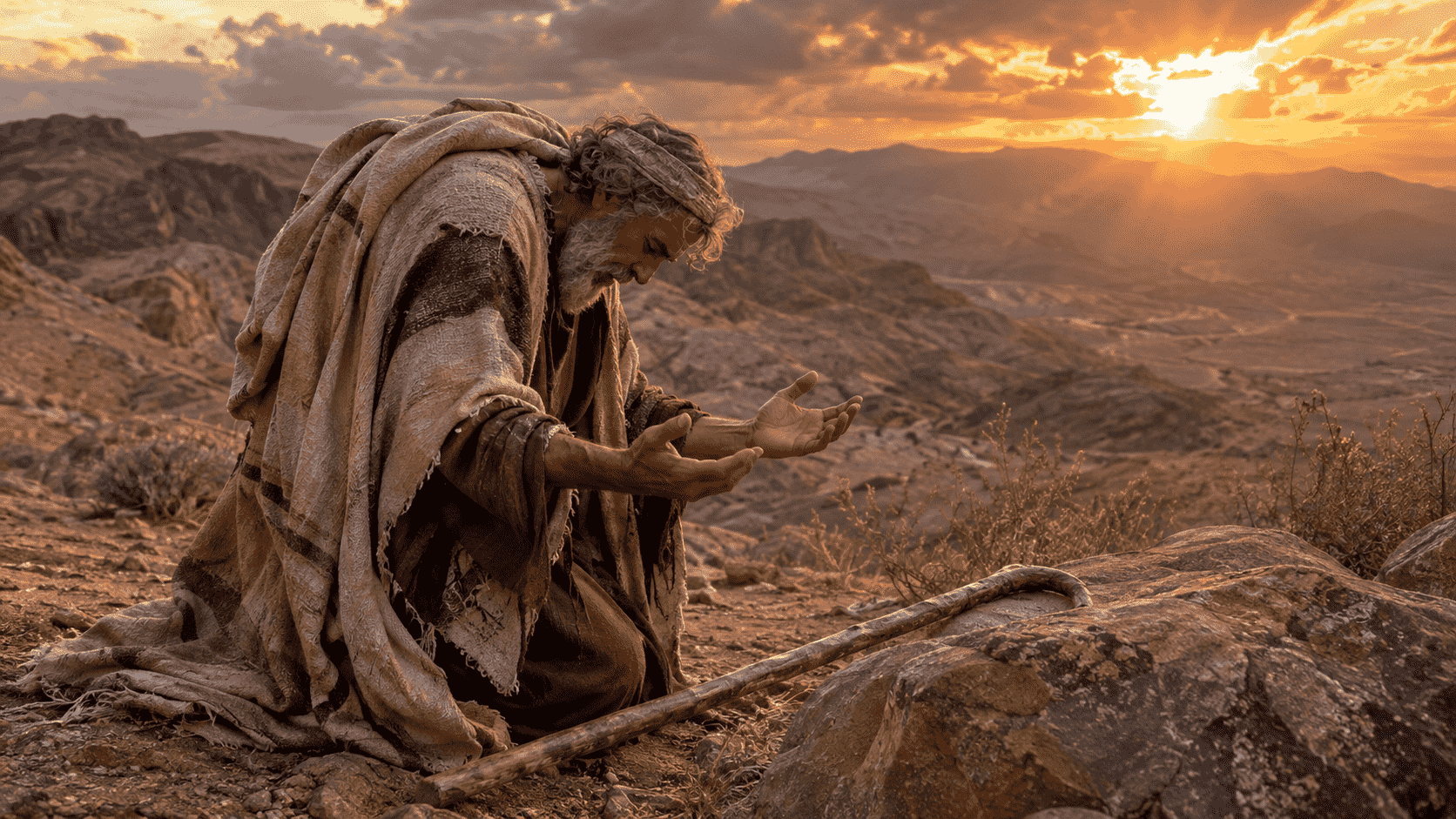
Moses in the Wilderness
Last week, we explored how God preserved Moses as an infant during one of the darkest periods in Israel’s history. Born under a death sentence, Moses was rescued through the courage of his family and raised in Pharaoh’s household. God was already at work long before Moses understood His purposes.
Now, forty years have passed. Moses has grown up surrounded by the wealth, education, and influence of Egypt. Acts 7:22 tells us he was instructed in all the wisdom of the Egyptians and was mighty in words and deeds. Yet beneath his privileged upbringing, Moses knew he belonged to the Hebrew people, who continued to suffer under Egyptian oppression.
What happens next changes the direction of his life. Moses attempts to intervene in an injustice, kills an Egyptian, and becomes a fugitive. The man who grew up in Pharaoh’s household finds himself living as a shepherd in the wilderness of Midian.
Moses would spend forty years in Egypt, forty years in Midian, and forty years leading Israel. His life reminds us that God can use seasons of failure, uncertainty, and obscurity to prepare us for responsibilities we cannot yet imagine.
1. Good Intentions Do Not Justify Wrong Actions
Read Exodus 2:11–15 and Acts 7:23–25.
When Moses saw an Egyptian beating a Hebrew, he recognized the injustice being committed against his people. Rather than ignoring their suffering, he chose to intervene. But Moses responded by killing the Egyptian and hiding his body in the sand.
Acts 7:25 tells us Moses believed his brothers would understand that God was giving them salvation by his hand. Yet they did not understand, and Moses’ attempt to intervene ended in rejection and exile.
His concern for his people was understandable, but his actions were not justified simply because his intentions were good.
How often do we recognize a legitimate problem but respond in an unhealthy way? We may attempt to control a situation, force an outcome, or act out of anger because we believe something needs to change.
Being right about a problem does not automatically make us right in how we respond to it.
God calls us not only to pursue what is right, but to pursue it in ways that honor Him.
Let’s Discuss
-
What do you think motivated Moses to intervene when he saw the Egyptian beating a Hebrew?
-
Have you ever tried to resolve a legitimate problem but made things worse because of how you responded?
-
How can we distinguish between acting courageously in faith and trying to force an outcome through our own strength?
2. When Our Plans Fall Apart
Read Exodus 2:15–22 and Hebrews 11:24–26.
Moses fled Egypt after Pharaoh learned what he had done. The man raised in royal privilege became a stranger in Midian.
There, Moses encountered the daughters of a priest named Reuel, also called Jethro, and defended them when shepherds attempted to drive them away from a well. Eventually, Moses married Zipporah and began building a life far removed from the Egyptian palace.
Hebrews 11:24–26 reflects on Moses’ faith, describing how he refused to be identified merely as Pharaoh’s daughter’s son and chose association with God’s people rather than the temporary pleasures of sin.
Yet choosing to identify with God’s people did not mean Moses always acted wisely. His life contained both genuine faith and serious failure.
For forty years, Moses lived in Midian. Scripture gives us relatively few details about this period, so we should be careful not to assume everything God was doing in his heart. But the contrast is striking: Moses went from a position of privilege in Egypt to an ordinary life in a foreign land.
Sometimes God allows the lives we expected to fall apart. Our plans, accomplishments, and sense of identity may be challenged. But losing a position, an opportunity, or our sense of control does not mean God has finished working in us.
Failure does not have to be the final chapter of our story.
Let’s Discuss
-
What do you think would have been most difficult for Moses about leaving Egypt and beginning a new life in Midian?
-
Why do men sometimes connect their identity and worth to their careers, accomplishments, influence, or ability to solve problems?
-
When something we have worked hard to build falls apart, how can we respond with humility rather than bitterness or self-pity?
-
What is the difference between learning from our failures and allowing those failures to define us?
3. God’s Timing Is Not Our Timing
Read Acts 7:29–30 and Exodus 2:23–25.
Acts 7:30 tells us that forty years passed before God appeared to Moses in the wilderness near Mount Sinai.
Imagine that length of time. Moses had been raised with the education and opportunities of Egyptian royalty. He had recognized the suffering of his people and apparently believed he could play a role in their deliverance. Yet decades passed before God called him to return to Egypt.
Meanwhile, the Israelites continued to suffer.
Exodus 2:23–25 describes how the people groaned under slavery and cried out to God. Scripture tells us that God heard their groaning, remembered His covenant with Abraham, Isaac, and Jacob, saw the people of Israel, and knew.
God’s remembering did not mean He had previously forgotten. It emphasized His continuing faithfulness to His covenant.
The Israelites had not yet seen their deliverance, and Moses had not yet received his calling. But God had not abandoned either of them.
We often interpret waiting as inactivity. Yet Scripture repeatedly reminds us that God’s timing and purposes are greater than our immediate understanding.
Waiting on God is not the same as being forgotten by God.
Let’s Discuss
-
Why is waiting especially difficult when we believe something needs to change immediately?
-
Have you experienced a season when you felt overlooked, unproductive, or uncertain about what God wanted from you?
-
How can we remain faithful in our present responsibilities without becoming consumed by what we hope God will do next?
Life Application — Learning to Surrender Our Strength
Moses’ story challenges the way many men understand strength.
We are often taught to solve problems, take charge, protect others, and make things happen. Those qualities can be valuable, but they become dangerous when we begin trusting our own abilities more than God’s wisdom.
Moses had education, influence, courage, and a desire to help his people. Yet none of those qualities gave him permission to act outside God’s righteous ways.
His years in Midian remind us that our usefulness to God is not measured solely by our position, productivity, or accomplishments.
Some of us may be in a season of waiting. Others may be dealing with consequences from decisions we regret. Still others may be holding tightly to a situation we believe we must fix.
The challenge is not to become passive or irresponsible, but to learn the difference between faithful action and controlling outcomes.
Let’s Make It Personal
-
Where in your life are you currently relying more on your ability to control a situation than on God’s wisdom and direction?
-
What would surrendering that situation to God look like in practical, obedient action this week?
Closing Encouragement
Moses’ failure in Egypt did not disqualify him from God’s future purposes. His years in Midian were not the end of his story.
But Moses’ hope was never found in his education, courage, accomplishments, or ability to recover from failure. His hope rested in the faithfulness of the God who had made a covenant with His people.
The same is true for us.
God can redeem painful experiences, teach us through our mistakes, and continue shaping our character through seasons we would never have chosen.
Our greatest strength is not found in our ability to control the outcome, but in our willingness to trust and obey the Lord.
Next week, we will see how God meets Moses at the burning bush and calls him to return to the very place he once fled.
Closing Prayer
Heavenly Father, thank You that our failures do not have to define our future. Forgive us for the times we have relied on our own strength, acted out of frustration, or tried to control situations rather than trusting You. Teach us humility in our mistakes, patience in our waiting, and faithfulness in our daily responsibilities. Help us recognize that our identity is not found in our accomplishments or positions, but in our relationship with You. Continue shaping us into men who act with courage, walk in humility, and trust Your wisdom and timing. In Jesus’ name, Amen.